Should Your Fort Worth Small Business Elect S-Corp Status in 2025?
When you set up a business in Texas, one of the first questions is how to structure it. Sole proprietor, LLC, partnership, or S-Corp.
Each has its own rules, and each affects how you pay taxes. If you have heard about the potential tax savings of electing S-Corp status, you might be wondering if it makes sense for your small business in 2025.
How to Pay Yourself Through an S-Corp (Salary vs. Distributions)
Once your business becomes an S-Corp, you cannot take money out the same way you did with a sole proprietorship or LLC. You now have two ways to pay yourself: salary and distributions.
Salary
The IRS requires S-Corp owners to pay themselves a reasonable salary. This means you become an employee of your own business and must run payroll. Salary is subject to both income tax and payroll taxes.
What Is Reasonable Compensation for S-Corp Owners in Texas?
When you elect S-Corp status, one of the most important rules is paying yourself a reasonable salary. The IRS expects you to treat yourself like an employee, and the salary you set matters.
What Does “Reasonable” Mean?
Reasonable compensation is the amount you would pay someone else to do the same job you do. It is not a set number. It depends on your industry, your role in the business, your skills, and the time you spend working.
For example, if you run a consulting business in Fort Worth and handle most of the client work yourself, your salary should reflect what another consultant would earn in the area.
S-Corp vs. LLC in Texas: Which Structure Is Better for Taxes?
If you are starting a small business in Texas or thinking about changing your structure, two of the most common options are LLC and S-Corp. Both are pass-through entities, but they have key differences when it comes to taxes.
Let’s look at it simply.
LLC Basics
An LLC is flexible and simple to run. The profit flows directly to you, and you report it on your personal tax return. The drawback is that all profit is subject to self-employment tax.
Curious how much you could save by switching to an S Corporation? Use our interactive calculator to see the difference. Just enter how much you plan to withdraw from your business each year and choose what portion you’ll take as salary versus distribution. The calculator will show you your potential tax savings, instantly.
When NOT to Elect S-Corp Status for Texas Business Owners
Most of the advice you’ll hear about S-Corps is focused on how they save business owners money. And yes, in the right situations, that’s absolutely true. But what’s often left out of the conversation is that S-Corp status doesn’t always make sense. For some business owners, the extra paperwork, payroll requirements, and IRS rules can cancel out the savings.
If you’re running a business in Fort Worth and thinking about filing the election, it’s worth looking at the situations where an S-Corp can actually hurt more than it helps.
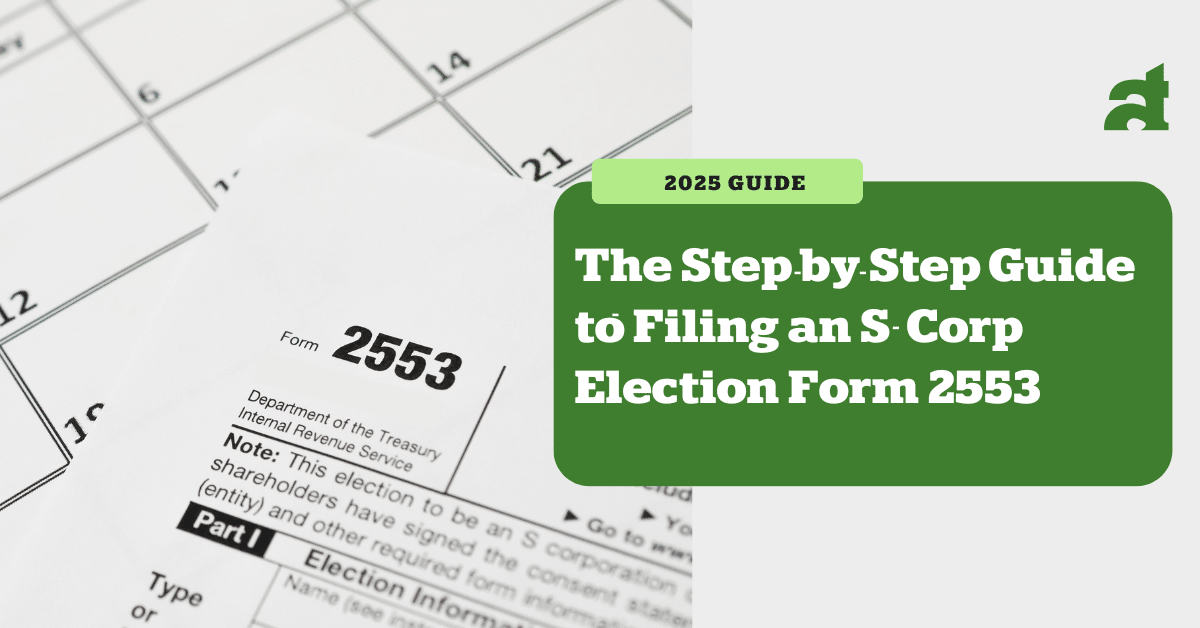
The Step-by-Step Guide to Filing an S-Corp Election (Form 2553)
If you’ve decided an S-Corp election makes sense for your business, the next question is how to actually make it happen. The good news is the process is fairly straightforward.
The catch? The IRS has strict rules about timing and paperwork, and missing a step can push your election back an entire year.
This guide walks through everything a Fort Worth business owner needs to know to successfully file Form 2553 and start reaping the tax benefits of an S-Corp.
Common S-Corp Mistakes We See in Fort Worth (and How to Avoid Them)
Electing S-Corp status can save Fort Worth business owners thousands in self-employment taxes, but it also comes with rules that can trip you up if you’re not careful.
We regularly see business owners jump into the election, only to run into problems that cost them money, trigger IRS scrutiny, or wipe out the very savings they were hoping to get.
If you’re thinking about an S-Corp for 2025 or already running one, here are the most common mistakes we see and how you can avoid them.
How S-Corps Save on Self-Employment Taxes (and Where They Don’t)
One of the biggest reasons Fort Worth business owners consider electing S-Corp status is the potential savings on self-employment taxes. If you’ve ever felt frustrated watching a huge chunk of your profits disappear into Social Security and Medicare, you’re not alone. The S-Corp election is designed to help reduce that burden.
But here’s the catch: while S-Corps can definitely save you money, the savings aren’t unlimited. There are clear rules about how it works, and situations where it doesn’t.
S-Corp Year-End Checklist for Fort Worth Business Owners
Running an S-Corp can deliver serious tax savings, but it also comes with year-end responsibilities that you can’t afford to overlook.
Unlike a sole proprietorship or single-member LLC, you now have payroll, corporate filings, and tax forms that must be squared away before December 31.
If you own an S-Corp in Fort Worth, here’s a practical checklist to make sure you close out the year correctly and avoid IRS headaches.