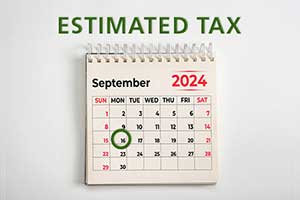
If you are self-employed, an S-Corp owner, a partnership owner, or a high earner with non-wage income, the IRS expects you to pay tax during the year, not just at filing. Quarterly estimated tax payments are how. Miss them and you owe the underpayment penalty (currently 8% annual, compounded daily) even if you eventually pay the full balance in April.
Quarterly estimated tax payments are prepayments of federal income tax made four times a year by taxpayers who do not have enough tax withheld from a paycheck. The IRS expects you to pay tax as you earn it, not in a lump sum at filing time. If you miss the threshold, you owe the underpayment penalty even if you eventually pay the full balance in April.
Quarterly estimates apply to self-employed business owners (Schedule C), S-Corp and partnership owners (K-1 income), investors with significant non-wage income, retirees with pensions or distributions exceeding withholding, and high-earning W-2 employees whose flat withholding falls short of actual tax owed.
The IRS requires quarterly estimates if you expect to owe at least $1,000 in tax for the year AND your withholding plus refundable credits will not cover the smaller of 90% of current-year tax or 100% of prior-year tax. For high earners with prior-year AGI over $150,000, the safe harbor jumps to 110% of prior-year tax.
Practically: if you are a sole proprietor netting more than $5,000 in self-employment income, an S-Corp owner with material distributions, a partnership owner, or a high-earning employee with significant equity or interest income, you almost certainly owe quarterly estimates.
If a deadline falls on a Saturday, Sunday, or federal holiday, it shifts to the next business day. The quarters are not equal — Q2 is only 2 months. This matters when you are calculating annualized income for the current-year projection method.
Two methods. The safe harbor method: divide last year’s total federal tax by 4 and pay that amount each quarter. This protects from the underpayment penalty regardless of how current-year income turns out. Best for predictable income.
The current-year projection method: estimate this year’s taxable income, calculate tax using current brackets, subtract any withholding and refundable credits, divide the remaining liability by 4. Works better when current-year income is significantly lower than prior year. Worse when income is significantly higher (because you may still under-pay).
For high earners with prior-year AGI over $150,000, the safe harbor requires 110% of prior-year tax, not 100%. Plan accordingly. See our $150K+ Texas earner tax strategy for the broader high-income planning framework.
Federal estimated tax can be paid via IRS Direct Pay (free, debit from bank account), EFTPS (free, but requires advance enrollment), debit/credit card (third-party fee applies), check by mail with Form 1040-ES voucher, or via the IRS2Go mobile app.
We recommend EFTPS for business owners with regular quarterly payments — it lets you schedule all four payments at the start of the year, eliminating the risk of forgetting. Direct Pay is simpler for one-off payments. Card payments come with a 1.85-1.96% processing fee that adds up over time.
The IRS underpayment penalty is currently 8% annually, compounded daily. The penalty is calculated separately for each quarter you under-paid, applied to the shortfall for the period it was outstanding. A taxpayer who skipped Q1 entirely and made it up in Q4 owes penalty on the Q1 shortfall for 9 months.
The penalty disappears if you meet either safe harbor: 100% of prior-year tax (110% for high earners) OR 90% of current-year tax. Aim for one of these even when current-year income is higher than expected.
Yes, and it is often easier. The IRS treats withholding as paid evenly across the year regardless of when it actually occurred. So if you discover in November that you have under-paid, you can request a large additional withholding from December paychecks and avoid most of the underpayment penalty.
This trick is particularly valuable for W-2 employees who have side-business income, exercise stock options late in the year, or receive a large bonus they did not withhold against. File a new Form W-4 with a high additional withholding amount, then revert to normal after the catch-up period.
Always pay quarterly. The year-end true-up approach costs the underpayment penalty (8% annual) plus the convenience of having a clear cash-flow picture during the year. For most small business owners netting $50,000 or more, the quarterly discipline also forces better tax planning during the year.
If quarterly estimates feel like a guess-and-pray exercise, that’s a sign you do not have a real tax projection process. Let’s set up a year-round projection so quarterlies are accurate, predictable, and never a surprise.
Until next time.
You must pay quarterly estimated taxes if you expect to owe at least $1,000 in tax for the year after subtracting withholding and refundable credits, AND your withholding plus credits will be less than the smaller of (a) 90% of current-year tax or (b) 100% of prior-year tax (110% if prior-year AGI exceeded $150,000). Most self-employed business owners, gig workers, and high earners with W-2 under-withholding owe quarterly estimates.
Q1 by April 15, Q2 by June 15, Q3 by September 15, and Q4 by January 15 of the following year. If a date falls on a Saturday, Sunday, or federal holiday, the deadline shifts to the next business day. The quarters are not equal calendar quarters — Q2 covers only April through May.
Two common methods: (1) Safe harbor — pay 100% of your prior-year tax in four equal installments (110% if prior-year AGI exceeded $150,000); this protects from underpayment penalty regardless of current-year income. (2) Current-year projection — estimate current-year taxable income, calculate the tax, divide by 4. The safe harbor is simpler but can result in larger overpayments or underpayments if income changes significantly.
The underpayment penalty is currently 8% annually (compounded daily), applied to the shortfall for the period it was outstanding. Missing one quarter typically costs $100-$500 for moderate earners and several thousand for high earners. Compounds with any other underpayment penalties already accruing.
Yes. C-Corporations must pay estimated tax if they expect to owe $500 or more for the year. Corporate quarterly deadlines: 15th day of the 4th, 6th, 9th, and 12th months of the corporation’s tax year (typically April 15, June 15, September 15, and December 15 for calendar-year corporations). S-Corporations pass through income to shareholders who pay quarterly estimates personally.

Adam Traywick, CPA is the President and founding CPA of Adam Traywick, LLC, a Fort Worth small-business accounting firm. He has over 20 years of experience helping small business owners across home-services trades, hair salons, real estate, and insurance agencies optimize taxes, run cleaner books, and avoid the surprises that come from once-a-year accountants.